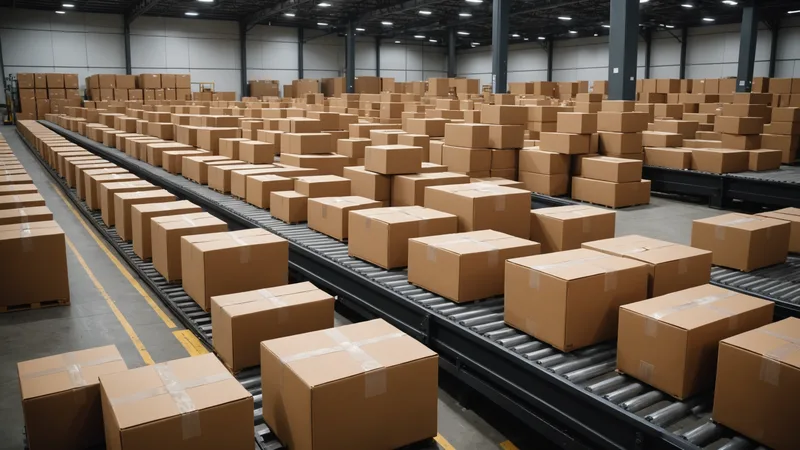
I have spent a fair amount of time in 3PL facilities watching robotic sortation systems work and fail. The failure pattern is usually the same: the system was designed around a SKU catalog that existed when it was installed, and that catalog no longer matches what comes down the inbound belt. A new client onboarded. A fulfillment surge brought in product categories the system had never seen. A returns wave arrived with items that were repacked in non-standard packaging. The robotic sortation arm faults, or misroutes the item, or passes it to the manual exception line that was supposed to handle only 5% of volume and is now handling 25%.
This is not an edge case. It is the normal operational condition for any facility handling mixed retail and e-commerce volume. The variance is the baseline, not the exception.
The Catalog Dependency Problem
Traditional robotic sortation systems build their recognition models around a curated SKU catalog. For each item type, you provide training images or CAD geometry, configure the classifier, and validate its identification accuracy before go-live. The resulting system identifies items reliably within that catalog and escalates anything outside it to manual handling.
The problem is catalog maintenance. In a 3PL environment handling 50-200 active clients, the effective item space can be tens of thousands of SKUs with continuous turnover as clients add and remove products. Keeping a robotic sortation system's catalog current with that rate of change requires ongoing engineering time: acquiring new product images, triggering retraining, validating the updated model, and deploying it to the production system without disrupting the line. In practice, the catalog always lags the floor. The gap between "what the arm knows" and "what comes down the belt" tends to grow over time.
The manual exception rate tracks that gap. When the catalog is fresh and the item mix is stable, the arm handles a high fraction of volume autonomously. When catalog lag builds up during a busy period when there is no bandwidth to retrain, exception rates climb. This is the pattern I have seen across multiple medium-to-large scale 3PL operations. The robotic system underperforms most precisely during the periods of highest volume, when the item variety is broadest.
What VLA-Based Sortation Does Differently
A VLA model for sortation does not maintain an item-type catalog in the traditional sense. It processes each item from visual input at runtime and conditions its sortation decision on the task context you provide: route this size class to lane 3, route anything that appears to be a poly bag to lane 7, items with these characteristics go to the exception chute. The routing logic is expressed as language-conditioned behavior, not as a classifier trained on specific product images.
In practical terms, this means the system can handle items it has never been explicitly trained on. An unfamiliar consumer electronics box arrives on the belt. The model has not seen that specific product, but it can reason about its physical characteristics, infer the appropriate size class, and route it correctly. A poly bag arrives that looks different from any poly bag in a training set. The model's learned concept of "poly bag" generalizes to cover it.
The routing logic is also easier to update. If the facility adds a new sort destination, you update the task prompt to include it. You do not retrain the model. The new sort lane becomes part of the routing specification immediately. This matters most for facilities with dynamic sort plans: different sort configurations for different clients, different shift priorities, seasonal routing changes. These can be handled through prompt updates without retraining cycles.
Where This Approach Hits Its Limits
I want to be honest about what does not work well here, because this is a real operational context and overstatements cause problems.
Barcode-dependent routing is outside the scope of what perception-based sortation handles. If your facility routes items by scanning a barcode to look up the item's destination in the WMS, you need the barcode scan whether you use traditional vision or VLA. Perception-based sortation adds value when items need to be physically classified and handled regardless of whether a scannable barcode is present, damaged, or non-existent. It does not replace barcode-based routing logic for items that have it.
Fine-grained product identification is also a different problem. Distinguishing between two similar products at the SKU level from visual appearance alone is genuinely hard. If your sortation requires distinguishing a 12-pack from a 24-pack of the same product by visual inspection, that is a task where explicit training on those specific variants matters more than generalization. The VLA approach handles categorical sorting well. Fine-grained SKU-level identification within a category still benefits from specific training examples.
High-speed sortation throughput above approximately 1,500-1,800 items per hour per arm is a real constraint. At those rates, inference latency starts to compete with takt time. The architecture decisions required to run inference overlapping with arm transit are feasible but add integration complexity. We are working on reducing base inference latency, but current production deployments are better suited to mid-rate sortation than high-throughput automated systems.
The Operational Pattern That Actually Works
Based on our pilot work, the facilities where VLA-based sortation delivers the most value share a few characteristics: they handle high SKU variety with continuous turnover, they have a meaningful manual exception rate with the current system (above 15%), and the labor cost of that exception handling is measurable and significant.
For a facility processing consumer returns with a broad and unpredictable item mix, the combination of lower exception rates and eliminated catalog maintenance work can represent several engineer-hours per week in ongoing operational cost reduction. That compounds significantly over a year of operation.
For a facility handling a narrow, stable SKU set with well-defined items, a well-maintained catalog-based system may actually perform better than the VLA approach. If your item space is 50 known SKUs that change twice a year, the overhead of maintaining the catalog is low and the traditional approach is well-suited. We are not saying catalog-based sortation is generally worse. We are saying it struggles with variance, and in high-variance environments, a different approach handles the distribution better.
Integration with Existing Conveyor and Sort Infrastructure
The EmbodyX integration for sortation works within the existing arm controller infrastructure. We connect through the arm's existing IO system for conveyor triggers and sort lane commands, so the physical integration does not require replacing existing sortation hardware. The main addition is the camera rig over the induction point, the edge compute unit running inference, and the SDK layer connecting our output to your arm controller. Standard UR, KUKA, and FANUC integrations are available. The configuration time for a standard induction-point setup has been in the 4-8 hour range across our pilot deployments, not counting the time to tune the sort routing prompts for your specific facility logic.
Sort routing prompt tuning matters more than I initially expected. The model handles the physical classification well out of the box. Getting the routing logic right for your specific facility, including edge cases in your sort plan and exception routing rules, takes iteration with people who know your operation. Budget for that time and involve your floor supervisors in the routing logic configuration, not just IT.