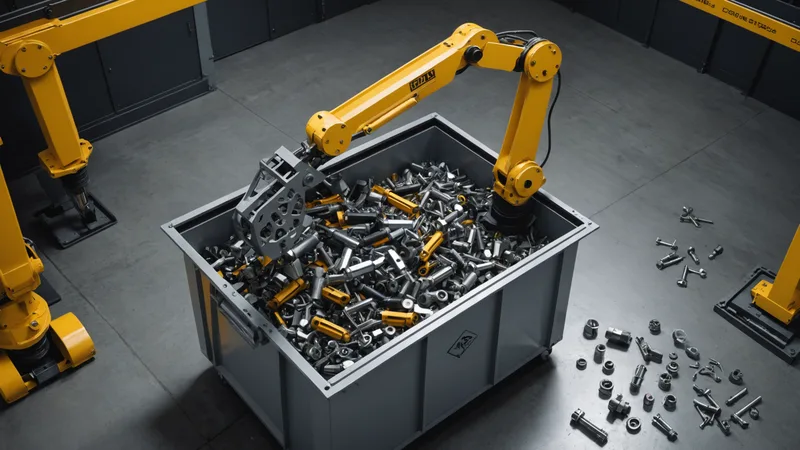
Bin picking has been on the "hard problems in industrial robotics" list since at least the early 2000s. The difficulty is not mechanical. Six-axis arms have had the reach and repeatability to pick parts from bins for a long time. The difficulty is perceptual: parts pile on top of each other, touch each other, occlude each other, and present different surfaces to the camera on every cycle. Getting the arm to generate a valid grasp for whatever configuration currently exists in the bin has required either expensive structured perception hardware, intensive engineering to model every part geometry in 6DOF, or accepting a fault rate that makes the system impractical.
A perception-first architecture changes the question you are asking. Instead of "does the current scene match the CAD model within our pose estimation tolerances," you ask "given what the camera sees right now, what is a physically feasible grasp." That is a different problem, and it has a different class of solution.
Why Traditional Bin Picking Systems Break Down
The standard approach to bin picking uses a point cloud segmentation pipeline: acquire a structured light or time-of-flight depth map, segment the cloud into candidate objects, run pose estimation against a stored 3D model to find a match within tolerance, project that match into the arm's task space, and execute the resulting grasp. Each stage introduces failure modes.
Pose estimation requires a clean match between the observed surface and the stored model. When parts are touching or stacked, the visible surface does not cleanly match the model. Transparent parts cause depth sensor artifacts. Highly reflective surfaces like polished metal fasteners saturate structured light systems and produce noisy or absent depth returns. Any of these conditions can push the pose estimate outside the acceptance threshold, causing the system to fault rather than attempt a grasp.
Adding part variants multiplies the maintenance burden. Each new part geometry requires a new 3D model, pose estimation calibration, and grasp parameter set. The per-part engineering cost is significant: a 4-6 hour project for a simple geometry, longer for complex castings or parts with surface features that affect the depth return.
The downstream effect on the factory is a system that works well on a narrow set of conditions and degrades faster than expected when anything outside those conditions occurs. In facilities that regularly receive parts from multiple suppliers with dimensional variation, or that change part mix frequently, the maintenance overhead can approach or exceed the original integration cost over the system's life.
What a Perception-First Approach Looks Like in Practice
EmbodyX's approach to bin picking does not run explicit pose estimation. The model looks at the scene and generates a grasp directly from the visual representation, conditioned on the task and any geometric constraints you specify.
In implementation, this means you provide the arm with a camera setup covering the bin, a task prompt that specifies what to pick and where to place it, and geometric bounds for the valid grasp regions. The model handles the rest at inference time. When the arm approaches the bin for a pick cycle, it queries the current camera frame, runs inference, and receives a target grasp pose. No stored model, no pose estimation pipeline, no template matching.
Parts touching each other are handled because the model's grasp output accounts for the actual scene, including contact geometry. Parts in arbitrary orientations are handled because there is no fixed reference orientation to fail against. Reflective surface variation from lot to lot is handled because the model is not computing a precise depth match; it is reasoning about visible affordances in the scene.
This is not magic. The model can fail on genuinely ambiguous configurations: a bin that is nearly empty with a single part at the bottom partially hidden under the bin lip is a hard case. But the failure mode is a low-confidence score and a pause for human review, not a hard fault requiring an engineer to retune the pose estimator.
A Realistic Look at Our Pilot Bin Picking Data
In our early-access pilot work (three facilities, 6-week evaluation period), we tracked task completion rates on bin picking tasks using EmbodyX against the preceding rule-based or 3D pose estimation systems those facilities were running.
For the mixed small-part manufacturing scenario, the baseline system was handling approximately 78-82% of cycles without human intervention. The remainder required either a fault clearance or a manual assist. With EmbodyX on the same parts and bins, that figure shifted to approximately 91-94%, based on our internal benchmark data from those evaluations. The remaining 6-9% went to low-confidence pauses where the model declined to attempt a grasp and flagged for review, rather than attempting a likely-to-fail pick.
We are cautious about generalizing from three facilities. Part geometry, bin configuration, camera setup, and surface finish all affect performance. What we can say is that the failure mode distribution changed: fewer hard faults, more graceful pauses. That changes the operational burden significantly even before the raw completion rate improvement.
Where Perception-First Bin Picking Still Struggles
Transparent or highly specular parts remain a challenge. Glass components and mirror-finish metal parts produce depth artifacts that can push the model into low-confidence states even when a human could clearly identify a valid grasp visually. We are working on multi-spectral and polarized light approaches, but this is a real current limitation.
Very high cycle rates with strict takt time constraints are also a constraint. At 8-10 picks per minute, the inference latency is within budget on the hardware we provision. At 20+ picks per minute, inference becomes a bottleneck unless you overlap it with arm transit time through careful lookahead scheduling. This requires cooperation between the EmbodyX inference pipeline and the arm controller's motion planner, which adds integration complexity.
Fine-pitch assembly operations are outside the current bin picking model's tolerance range. If the downstream operation after the pick requires sub-millimeter placement precision, you need fine-tuned model weights on your specific fixture and part combination. The base model handles flexible manufacturing well. Precision assembly requires the additional fine-tuning step.
What Does Not Change
The arm's end effector still needs to match the parts. A vacuum cup gripper that works well on flat surfaces will not pick deeply concave parts regardless of how good the perception is. Gripper selection is still a mechanical design decision. Perception-first approaches solve the scene understanding problem, not the grasping physics problem.
Integration with the facility's MES or WMS for task dispatch, bin refill alerts, and production logging still requires the same data plumbing work it always did. EmbodyX produces task completion signals that connect to standard PLC and SCADA integrations, but the integration itself needs to be configured per facility. We provide standard connectors for common platforms, but the configuration is not automatic.
The shift to perception-first bin picking is real and material for the right set of tasks. But it is a new class of solution to a specific set of problems, not a replacement for all the engineering work that surrounds a real production cell.